Please bookmark us in the new site. Looking forward to seeing you there!
2/10/2016
Please visit us in the new site!
This blog has been integrated into the Women's Action Nework website. (http://wan.or.jp/wwan) . New articles will no longer be posted in this blog, and this will only be available until the end of 2016. All of our previous articles have been moved to the new site, as well.

12/06/2015
Report on Women's Film Festival Osaka 2015

I went to the International Women Make
Sister Waves Film Festival, which was held on November 14 and 15, 2015, in Toyonaka
City, Osaka. Commemorating the 45th anniversary of women’s liberation movement,
the forth Film Festival was entitled “We’re Still in the Midst of Lib!” and a
total of seven documentary films were screened in two days. A special talk by
the women in their 70s about “the 45 Years of Women’s Lib—Never-ending Journey
on the Road of Lib—was also held, as well as discussions after screenings. The
Festival had other sorts of festivities, including panel exhibition showing the
women’s lib movement in Osaka and a party celebrating the movement’s 45th
anniversary.

The screening program of the Festival
included the premiere shows of three overseas films as
follows: Spanish and Turkish films documenting feminists movements which
spread in respective countries from the end of 1970s to 1980s, and a Canadian film,
Lesbiana: A Parallel Revolution*, which
reviewed the radical lesbians’ movement generated from the women’s lib movement
in the 1970s mainly through the interviews of those radical feminists. A
Japanese film Looking for Fumiko represented a dialogue between the women engaged in the 1970s lib
movement and younger generations. The other Japanese film 30
years' of Sisterhood : Women in the 1970s Women's Liberation Movement in Japan was composed of narratives of twelve women who had been involved in the lib
movement in those days and have been living a life for liberation still now.
Watching these films, I felt that I could vividly
re-experience the spread of various women’s movements simultaneously generated in various places of the world and
the power of solidarity among individual women who spontaneously took
part in the movements to let their voices heard. That was because the films
were directed by women who aimed to listen carefully to voices of those women engaged in the movements. Even though their problems and
difficulties were different from ours, we, who are living a contemporary life somehow
with uneasiness, could receive positive messages and hopes from each of those
films.
Above all, the words which I found most inspiring
were those uttered by a woman in the Spanish film about La Sal in Barcelona. “For
me, ‘feminism’ is uncomfortable behaviorism,” she said, “because you could never
keep away from feminism as it involves the questions of your own life and
identity, while you could forget about the missiles (she means other kinds of
social movements) you would not take home to your bed.” Yes! I agreed to those words with much empathy.
Another impressive phrase was spoken by a women
who appeared in Lesbiana: A Parallel
Revolution. She said “I think it necessary that we should be connected
through recognition of our heterogeneity rather than homogeneity." The linkage
based on heterogeneity might not be attainable particularly in Japan where homogeneity
tends to be most highly regarded. The importance of heterogeneity, however, should
be better appreciated in our actual activities and movements today.
Original article written by NAKAMURA Natsuko
Translated by FUKUOKA.A.A
11/29/2015
Making use of yourself to connect with society--Knowledge of philosophy and its use
Event URL : http://www.essor.or.jp/blog/kouza/2015-12-26
Organizer : Public Interest Incorporated Foundation Hiroshima Prefecture gender equality
Date : Saturday, December 26,2015 10:30-12:00
Venue : ESSOR Hiroshima conference room 2nd floor (11-6, Fujimi-cho, naka-ku, Hiroshima)
URL : http://www.essor.or.jp/
Contact: Tel:082-242-5262 FAX:082-240-5441 Email:essor@essor.or.jp
Brochure: Download
Detail : Inviting Mr. Hitoshi Ogawa, philosopher often appears on TV as a speaker, we will learn the importance of thinking things with the philosophical view. The theme is "Making use of yourself to connect with society--Knowledge of philosophy and its use" Fee is 500 yen, Free child service is available (Please book in advance).
Original Article on the WAN Website
Translated and Adapted by T. Muramatsu
Movie Review: Freedom Writers
Acquiring Their Own “Words” and “Voices” to Change Their Lives

Erin Gruwell, a novice high school teacher, comes in charge of a class composed of “at-risk” students. Growing up in slums where violence and murder happen every day, the students segregate themselves into the racial groups and fight against each other in the cycle of hatred, just like adults do outside of the school. They have no hopes in their own lives and no enthusiasm to learn. Nevertheless, Erin believes the power of education and, all by herself, begins struggling to change the students’ lives. She gives her students some books to read and diaries to write about themselves, because she believes that they can understand and empathize with others through reading and writing. She tries to teach them how big the world is and how to describe themselves in their own words.
Regarding her as a just another white woman from a rich family, the students disapprove and sneer at Erin. Erin doesn’t sympathize, look down or give up on them because she knows that their attitudes towards her result from their immaturity and pain. Instead, she respects each of her students as a person and gradually, her honesty touches a chord with them. They open up their hearts to her through their own “words” and “voices” they have acquired. This story touched me deep inside.
This movie is based on a best-selling book titled The Freedom Writers Diary, which was written by actual high school students and published in 1994. The every story in it is too harsh to believe that it’s true, but that is the reason why the students’ voices are filled with hopes (I recommend this book as well as the movie).
The theme song of the movie is “A dream” by COMMON feat. WILL. I. AM, which samples the famous speech by Martin Luther King Jr, “I Have a Dream”. Every time I listen to the theme, tears well up in my eyes and I think that there is no song that matches with the movie more perfectly than this song.
In this movie, Erin succeeds in developing trust with students and also letting them believe in the power of education, but there is one thing she has to lose: her husband. While she devotes herself in teaching her students to change their lives, he gives up his relationship with her and leaves her. The movie depicts him as a kind of pathetic man who can’t understand his wife’s passion for her career.
In closing, I’d like to ask you one question. If you had a career which you think you should devote your whole life to and choose over your partner, what would you do? Or, what would you do if your partner had such a career? If you were Erin or her husband, how would you deal with this unanswerable question?
Original Article by Natsuko NAKAMURA
Translated by N. Tajima
9/20/2015
“Force against terrorism only ends up generating new terrorism” --- OVERSEAs is now acting! Stop the “Galapagos bill” which ignores world trends!
On
August 28th, 2015, before massive protests around the Diet
Building on the 30th, a press conference was held by “OVERSEAs-PEACE for
World,” an organization of Japanese living abroad fighting against the security-related legislation, which enables the use
of collective self-defense right.
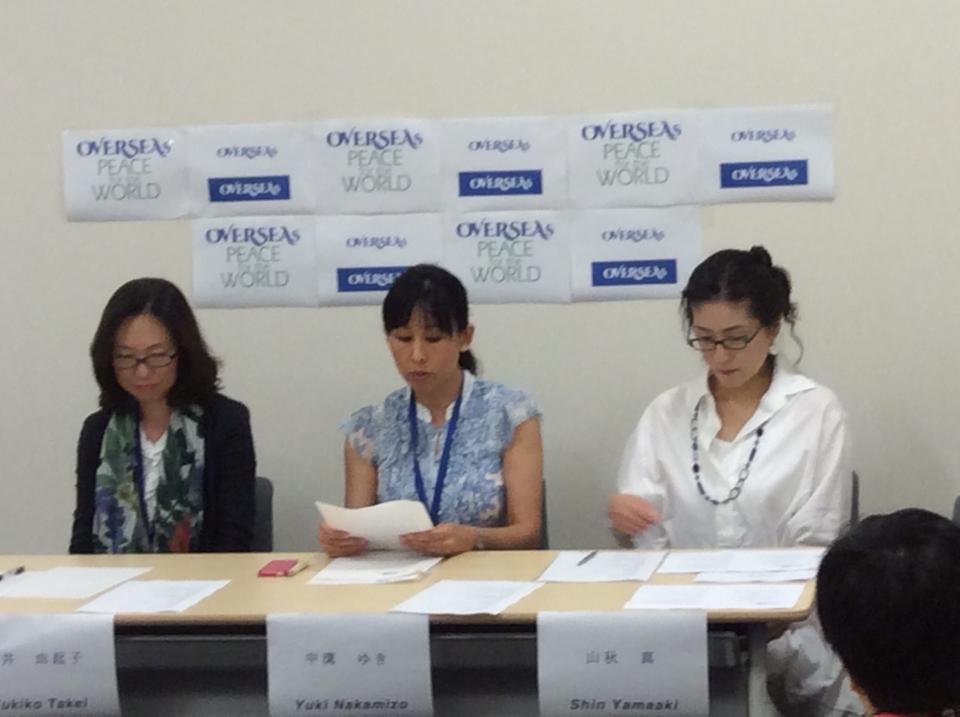
The three founders of OVERSEAs – Yukiko Takei, Yuki Nakamizo, and Shin Yamaaki --- attended the conference. Inspired by the many protesters and protest groups across the country including SEALDs, MIDDLEs and TOLDs, Takei called for the foundation of OVERSEAs in mid-August. In just a single week after its foundation, about 400 people had joined their closed group page on Facebook.
As of 13:00 on September 20th, OVERSEAs has got 2727 “Like”s on their Facebook community page (https://www.facebook.com/OVERSEAs発信版-980605138640687/timeline/) and 1,250 web signatures on their petition website (http://www.overseas-no9.net/). They are considering submitting the signatures to the Japanese consulates overseas.
As of 13:00 on September 20th, OVERSEAs has got 2727 “Like”s on their Facebook community page (https://www.facebook.com/OVERSEAs発信版-980605138640687/timeline/) and 1,250 web signatures on their petition website (http://www.overseas-no9.net/). They are considering submitting the signatures to the Japanese consulates overseas.
In
the protests on August 30th, they carried out a standing demonstration near the
Diet Building holding the blue placards of OVERSEAs. Also, their supporters in
Berlin and New York joined the protests with the same placards. They posted photographs
of their actions on Facebook to demonstrate their worldwide solidarity.
Viewed from abroad, we can see that “Japan is safe because it is considered to be a ‘weak country’ which cannot take military action.”

Yukiko Takei is a lawyer, who occasionally holds the
“Constitution Café” events as a member of the Association of Young Lawyers
Defending Tomorrow’s Freedoms, and watches over SEALDs as a member of Watching
Lawyers. Having once worked for a general trading company, she says, “When you
consider peace and security, you need to think about our
relationships with foreign countries.”
Those who advocate changes to the collective
self-defense legislation emphasize the “threat of China” and argue for the
necessity of military buildup. But she questions that argument, saying, “For
Japan there is no point in making war against China, which is one of Japan’s
biggest trading partners.”
Takei also says, “Japan is safe precisely because it is
‘weak.’” What does this mean?
Now, the nature of wars and conflicts around the world is
changing from “country against country” to “country against (cyber) terrorism.”
The aim of terrorists is to defeat “strong countries” like the United States.
She argues that in such a worldwide trend a “weak country” like Japan, which
has abandoned arms, is less likely to be targeted by terrorists, and therefore,
is safer.
It is true that modern-day terrorism is conducted in the
form of guerrilla warfare, in which overwhelmingly militarily (and also
politically and economically) weaker groups attack stronger powers.
This may result in those “strong countries” being forced
to spend much money, and as a result, end up reconsidering their policies. That
is exactly what the terrorists is looking for. Not to beat, to conquer or to
rule the powers.
Takei has, in fact, seen many Americans hiding their
passports trying to conceal their nationality in airports and on board
airplanes. Americans are likely to be targeted just for “being Americans.”
On the other hand, Takei has been proud to show that she
is “Japanese.” So far, most Japanese residents in foreign countries have lived
safely without being targeted by any specific political groups, because we have
not killed anyone in war with other countries for 70 years due to Article 9 of
the Japanese Constitution.
However, our security notion that “we are safe because we
are Japanese” will begin to disappear when Japan enhances its military power
and takes part in U.S.-led wars, and rapidly so.
Since the start of the Abe administration in December
2012, ten Nikki employees were among 40 foreigners who were kidnapped and
killed by pro-al-Qaeda militants in Algeria in 2013. And in January 2015, two
Japanese men were held hostage and killed by the terrorist group Islamic State
(IS).
In the horrible execution of the hostage Goto, IS sent a
frightening message saying, “(Prime Minister) Abe, with your reckless decision
to participate in an unwinnable war, this knife not only will massacre (Goto)
Kenji, but also continue and cause a bloodbath where your people are. Let the
nightmare begin for Japan.”
Abe responded to this with a very belligerent and risky
message, though sounding-brave; “To the terrorists,
we will never, never forgive them for this act … Japan will never yield
to terrorism ... (and) is firmly resolved to fulfill its responsibility in the
international community's fight against terrorism.” The Japanese government
could not do anything when its citizens were kidnapped. It could not save them.
It could hardly even negotiate with the terrorists. It revealed that it was
completely incompetent in protecting the lives and security of its citizens.
And yet Abe blustered, “We will never forgive IS.”
Obviously, IS will not sit by and will send more hostile
messages to the Japanese government. This exchange of bitter words could get
worse, but those put at a greater risk of suffering serious harm are ordinary
Japanese citizens.
Actually, according to the foreign press, Jumpei Yasuda,
a Japanese freelance journalist is now being held hostage by an unknown group
in Syria. But there has been little coverage of it in Japan. Many people believe
that the incident might have something to do with the government’s, especially
Abe’s, insensitive and overbearing attitude towards the Muslim extremists.
If the new collective
self-defense legislation enables the use of force by the Self Defense Forces
abroad, their potential enemies will certainly include such extremists. As a
result, Japanese people would be much more likely to become their “targets.”
Warning that Japanese people are about to throw away the wonderful fortune they
are not even aware of owning, Takei and her partners say, “We are strongly
against the collective self-defense bill which will never be conducive to
peace in Japan and the world. We should contribute to the world through culture
and economy, not military force.”
-------------------------------------------------------------------------------
Original article written by Independent Web Journal
Translated by A. Tawara
8/31/2015
California Scholars Rally Against Japan’s Proposed Security-related Bills on Aug. 27, 2015
A wave
of protest is brewing at home and abroad. According to the Association of
Scholars Opposed to the Security-related Bills (ASOSB), a large number of scholars
from over 100 universities both in Japan and overseas have released statements
against the government-sponsored security bills now under deliberation in the
Diet. One call to action was issued on August 27 by Keiko Yamanaka, a scholar
at University of California, Berkley, and some others based at UCB/UCD asking
for people in California was to join hands in protest against the bills. ASOSB
is calling for broader support and signatures on a petition available on their website.
*********************************************************************************
As scholars deeply concerned about Japan’s
constitutionalism and its future, we declare our strong opposition to the
so-called security-related bills that were passed by Japan’s Lower House on
July 16, 2015. Proposed by the Abe government, these so-called security-related
bills consist of 1) the International Peace Security Bill, and 2) the omnibus
Peace and Security Legislation Consolidation Bill that amends 10 war-related
laws. If passed by the Upper House this September, these bills would allow the
Japanese government to send Japan’s Self-Defense Forces to cooperate with
overseas military operations conducted by other countries. Many scholars of
constitutional law have pointed out that these security-related bills are
clearly in violation of Article 9 of the Japanese Constitution. By joining the
efforts of the Association of Scholars Opposed to the Security-related Bills (http://anti-security-related-bill.jp/images/link_california.pdf), we not only
express our opposition to the Bills, but also urge other concerned scholars in
California to voice their views. Please note that we are a group of scholars
based in California who have chosen to express our opposition to the
Security-Related Bills in Japan as individuals (See the next page for the list
of signatories). The opinions expressed in this statement are those of the
individuals, and they do not represent the views of the organizations and/or
institutions of their affiliations. If you agree to sign this appeal, please
contact one of the following: • Keiko Yamanaka (keikoyamanaka7[at]gmail.com) •
Byung-Kwang Yoo (yoobk15[at]gmail.com) • Junko Habu (habujunko[at]gmail.com). In your
message, please include the following information.
************************************************************************
1. I
agree to publicize the following information about myself
(Please check one of
the boxes below):
[ ] Name, academic
discipline, title, department and university
[ ] Name only
[ ] None
2. Your
Name:
3.
Academic Discipline:
4.
Title:
5.
Department and University:
6. Date:
7.
Comments (Optional):
See also a feature article (Call for Support: Sign the
Appeal against the Security-Related Bills) on the W-WAN website.
Posted by Naoko Uchibori
8/14/2015
“We Refuse Abe’s Politics” – Call for Action at 14:00 (German time) on August 15th, Saturday
ACTION: “We Refuse Abe’s Politics 0815” “Nein zu ABEs Politik 0815”
Date: Saturday 15th August
Time: 14:00 (German Time)
Let's wave placards!
Venue: In front of your house, in your house, in your office, etc. Take photos of your action and post them to Facebook.
FB: https://www.facebook.com/events/1614472758832999/
Placards: Japanese, German (Download from here.)
[Declaration]
On 15th July, The Japanese Lower House steamrolled security bills which a number of constitutional scholars consider as unconstitutional. The majority of the Japanese citizens are opposed to the bills.
If the Upper House approves the bills, Japan would be able to use military forces when Japanese allies such as the United States are attacked even if Japan itself is not directly attacked. It would also be able to dispatch the Self-Defense Forces abroad to provide logistics support to the military of its allies when they claim they are working for an international peace-keeping operation.
It's a significant policy change for Japan, which, for so many years, has been a pacifist nation renouncing war. Some point out that Japan will run the risk of having nuclear power plants targeted by missiles.
As a reaction against Prime Minister Abe's brutal politics, Hisae Sawachi, a novelist, led a protest against the bills.
The Asahi Shimbun reported the protest.
http://digital.asahi.com/articles/ASH7L7K7HH7LUTIL01N.html?iref=comtop_pickup_02
Sawachi and those who agreed with her launched a website.
718 response: http://718yobi.blogspot.jp/
Protest against the Japanese Government (Abe's Regime) in Germany
In Japan, on 18th July, at 1 PM, protesters waved the same placard at more than 1000 sites throughout the country.
We are going to do the same action in Germany on 15th August.
If you can join us, let's bring placards and meet in front of the art museum, K20 GRABBEPLATZ (Grabbeplatz 5, 40213 Düsseldorf).
Original article: http://net.wan.or.jp/now/?p=1802
Abridged Translation: Atsuko Ishikawa
Date: Saturday 15th August
Time: 14:00 (German Time)
Let's wave placards!
Venue: In front of your house, in your house, in your office, etc. Take photos of your action and post them to Facebook.
FB: https://www.facebook.com/events/1614472758832999/
Placards: Japanese, German (Download from here.)
[Declaration]
On 15th July, The Japanese Lower House steamrolled security bills which a number of constitutional scholars consider as unconstitutional. The majority of the Japanese citizens are opposed to the bills.
If the Upper House approves the bills, Japan would be able to use military forces when Japanese allies such as the United States are attacked even if Japan itself is not directly attacked. It would also be able to dispatch the Self-Defense Forces abroad to provide logistics support to the military of its allies when they claim they are working for an international peace-keeping operation.
It's a significant policy change for Japan, which, for so many years, has been a pacifist nation renouncing war. Some point out that Japan will run the risk of having nuclear power plants targeted by missiles.
As a reaction against Prime Minister Abe's brutal politics, Hisae Sawachi, a novelist, led a protest against the bills.
The Asahi Shimbun reported the protest.
http://digital.asahi.com/articles/ASH7L7K7HH7LUTIL01N.html?iref=comtop_pickup_02
Sawachi and those who agreed with her launched a website.
718 response: http://718yobi.blogspot.jp/
Protest against the Japanese Government (Abe's Regime) in Germany
In Japan, on 18th July, at 1 PM, protesters waved the same placard at more than 1000 sites throughout the country.
We are going to do the same action in Germany on 15th August.
If you can join us, let's bring placards and meet in front of the art museum, K20 GRABBEPLATZ (Grabbeplatz 5, 40213 Düsseldorf).
Original article: http://net.wan.or.jp/now/?p=1802
Abridged Translation: Atsuko Ishikawa
Subscribe to:
Posts (Atom)